Dashboard
See the count while it is happening.
Most inventory software tells you how the count went. This tells you how it is going — from every warehouse at once, updating every five seconds. It is free, and it is part of Stocktakes Online.
Four questions, asked all day.
How far through are we? Will we finish tonight? Has anyone stopped? Is that number right? They normally get answered by walking the floor and asking somebody. The Dashboard answers them on a screen, from the counts themselves, while the count is still running.
The bin sweep map.
Every bin location at a site, drawn as the rack it actually is — aisle by aisle, level by level.
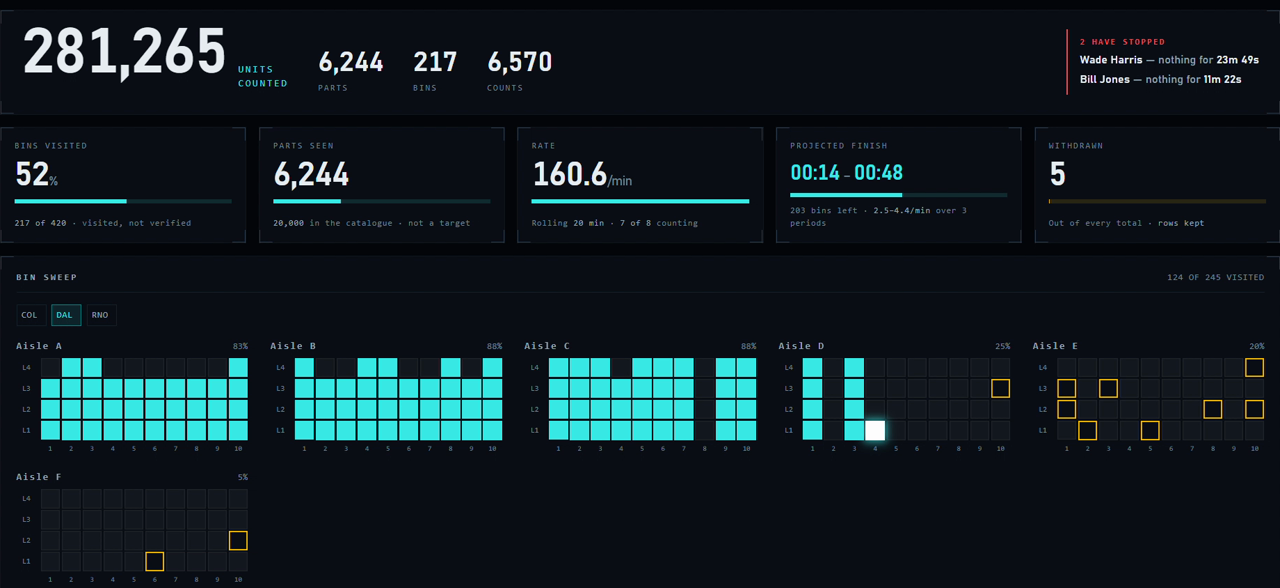
Counted, empty, and not yet
A bin looked in and found bare is not the same as a bin nobody reached, and once the count is closed they read the same in every total. The map is where you can still tell them apart.
Level 4 lags, and you can see it
The top of the rack needs a forklift, so it gets left. Drawn as an elevation rather than a flat strip, that gap is obvious at a glance instead of being averaged away into a percentage.
One site at a time
A bin code is unique within a warehouse, not across them, so one map cannot honestly show two. Switch sites, or let a wall display rotate through them.
The numbers, and what they are not.
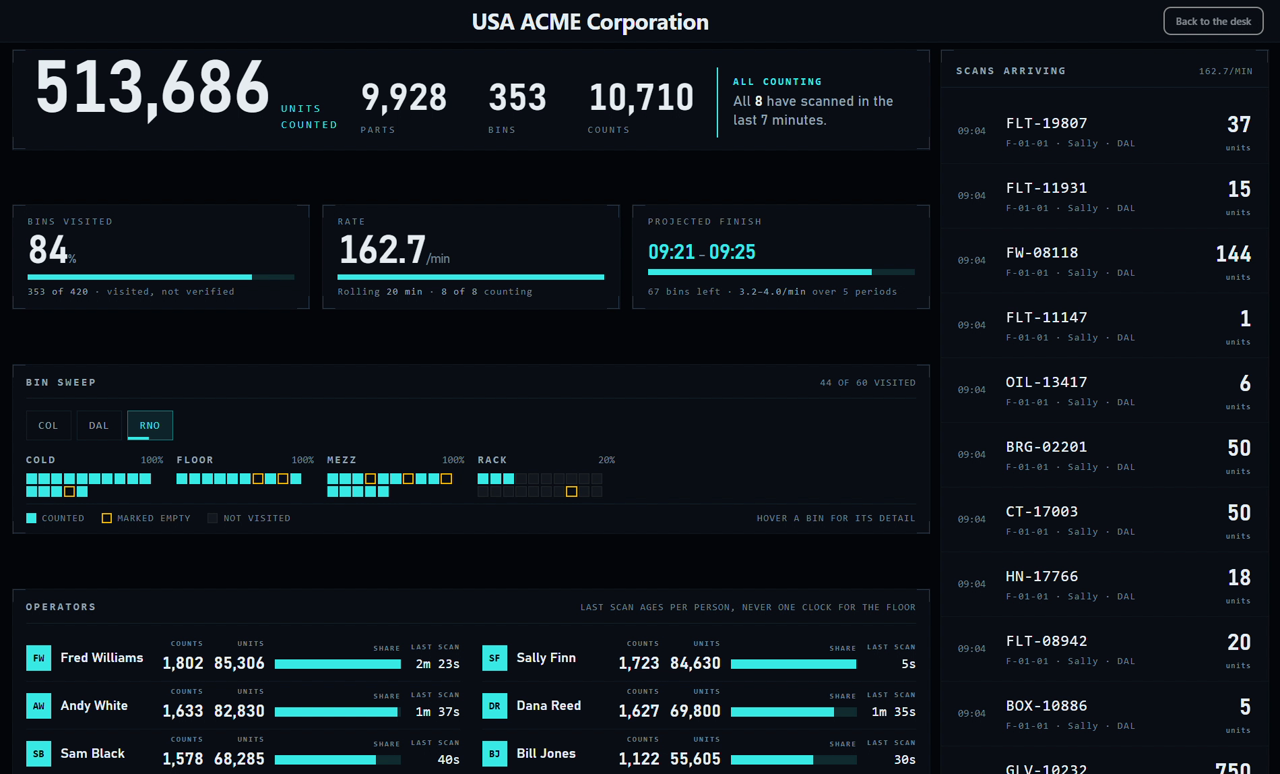
Rate, over twenty minutes
Rolling, not an average across the whole count — which converges on meaningless by the afternoon and says nothing about whether the floor is still moving.
A range, or nothing
Not a single time — one slow aisle moves that by half an hour. The two ends come from the fastest and slowest twenty minutes this count has actually managed, and it stays blank until there is enough counting behind it to mean anything. Past a day’s work left, it stops guessing and says so.
Who has stopped
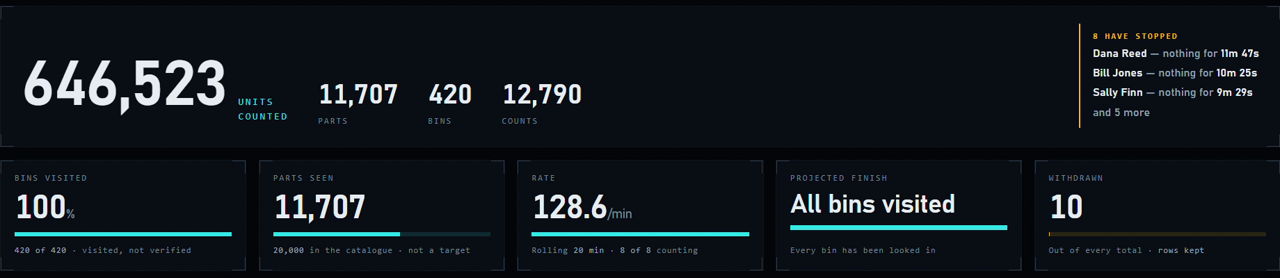
Named, with how long since their last scan. A scanner that went flat at 2pm is worth knowing about at ten past, not at quitting time.
Every operator's count
How many, how much, how many bin locations, how fast, and when they last scanned, ranked by what they have counted.
Scans arriving
The last counts as they land — part, bin, quantity, who, and which site. The scanner stores nothing, so what is on this list is what is recorded.
A wall display
The same screen with the furniture stripped off, sized for a TV in the warehouse office, rotating through each site in turn.
Worth a look.
Five things the counts themselves say are odd. None of them is an error, nothing is changed and nothing is deleted — they are facts already recorded, put where somebody can see them while there is still time to walk over and check.
Over the books
A count more than ten times what your accounting file expects for that part. Usually a carton counted as a unit.
Typed at the maximum
A count keyed at the scanner's ceiling. Operators taught on older systems type 9999 to mean “none”, and have done for years.
Counted twice in one bin
The same part counted twice in the same bin location by the same person. Both stand — a part can sit in two places in a big location — but it is worth a look.
Entered and withdrawn
A count the operator took back. The row stays, out of every total, so an administrator can see a figure was withdrawn rather than finding a gap.
One bin, two people
The same part in the same location counted by two different operators. Either the work was done twice, or two people disagree about one shelf.
It is new, and you would be among the first
Built in October 2026, against a test warehouse of 20,000 parts and 420 bin locations across three sites — which is where the video above comes from. It has not yet been used on a customer's count. If you run one with us this year you will be among the first to use it, and we would like to hear what it gets wrong.
It is dark when the rest of the portal is not, on purpose: it is the one screen in the system you watch rather than read, and it is meant to be legible from across a room.